
My name is Lyn Mettler and I’m a 2013 Catholic convert, who never dreamed I’d become Catholic! Here I take a deep dive into Catholicism but from the perspective of someone new to the faith. Whether you’re new to Catholicism or a longtime Catholic ready to learn more, join me. To receive emails of my new posts, please subscribe below.

A Catholic Understanding of Suffering: One of the Most Amazing Things I’ve Learned
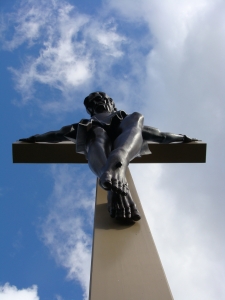
Redemptive sufferingMy most recent Catholic theme seems to revolve around suffering. The idea keeps emerging in the books I’m reading, on Catholic radio, in homilies and more … and wow is it a revelation! Catholics hold to the idea of “redemptive suffering,”  which turns the traditional understanding of suffering on its head, making it a positive, wonderful thing (bear with me :), I’ll explain in a minute).

While I’m not undergoing any true suffering myself (thanks be to God), it’s certainly a topic I’ve always grappled with and I think many nonbelievers do, as well. How could a loving, merciful God allow suffering?

Let’s start by saying we can’t know exactly. Afterall, we cannot know the mind of God, at least not until we reach our glory. That said, there are some clues to the meaning of suffering that we can follow. Let’s start with the greatest suffering of all time: Christ on the Cross.

Christ suffered unbearably, through torture, humiliation, mocking, and what must have been pain beyond belief. Yet, did you notice the greatest good of all time that it produced? Salvation for all who accept it! What can we learn from this? Suffering = Good.

Crazy, I know.

Here’s another clue. If you study the life of the saints, so many of them underwent great personal suffering, especially bodily suffering. Why would God punish them so? Perhaps because it’s not a punishment, but a gift — a wonderful thing.

I am reading a book right now that is the diary of a woman named Elisabeth Leseur who lived in the early 1900’s in France. She is up for sainthood but no progress has been made as of yet. Elisabeth, who was subject to much suffering — both mental and physical — looked upon this suffering as a way to “work” for God. She was married to an atheist, whom she loved dearly and whom she deeply desired to convert, but instead he argued and dissuaded her in her religion, causing her much personal grief.

She says repeatedly in her diary that words and actions do little for her hopes and desires for those souls around her, but rather suffering, prayer and mortifications (fasting, enduring discomfort, etc.) do the greatest work. So instead of complaining or arguing with her husband, she kept her sufferings inside and offered them up to God for the work of converting her husband. Can you imagine the power of using that same principle for problems in your own life?

This reminds me so much of my dear confirmation saint, St Therese of Lisieux, who gave glory to God and worked to help souls —  those of unbelievers, those in purgatory, her loved ones — in her “little way” of doing small acts of sacrifice for God. She too says that prayers, combined with fasting and almsgiving/charity are the quickest way to make your prayers heard.

Elisabeth desired to do much more with her life, but instead was confined to bed for various illnesses throughout her life. She determined that God’s true vocation for her was to “work” through suffering, which she was able to do so well by offering her sacrifices and all works for the intentions of others, so often for those in purgatory.

I recently was watching Super Saints on EWTN with Bob and Penny Lord in an episode about St. Philip Neri. It was said that he too offered many masses and prayers for the souls in purgatory, and when he arrived in heaven, they all greeted him, sharing that they had been praying for him since getting to heaven in gratitude for his kind prayers for them. What a wonderful thought!

If you’ve hung on with me this long, let this be some validation of suffering as the greatest “work” for God. Upon Elisabeth’s death, her long atheist husband converted to Catholicism, and not only that, he became a priest and was the one responsible for publishing her diary that it might help others. I find that to be a true miracle, but one that I have no doubt God granted for Elisabeth’s tireless work.

Let me end with this paragraph from Elizabeth’s diary, so eloquently put, moreso than I can:

“Union with Jesus Christ, which we shall realize in Heaven in joy and vision, is already possible for us on earth in suffering. That is why all souls in love with Jesus, those souls that have heard the  mysterious and irresistible call of Christ, love suffering and, far from rejecting it with an entirely human horror, ask for it, desire it as the sweet forerunner of the Master, as that which ushers us into His presence. It is suffering that reveals the Cross to us, that opens the divine Heart to us, that enables us to enter into this supernatural world that no human thing can reach, which we will know only in eternity, but from which a glimmer shines over us through the grace of suffering and the radiance of the Cross.” — My Spirit Rejoices by Elisabeth Leseur, Sophia Institute Press, 1996.


Superman’s Man of Steel Leads us to Catholicism

Man of Steel CatholicismMy family is a big fan of Superman. My boys love to dress in red capes, color pictures of the Man of Steel and watch episode after episode of the former TV show Smallville. My husband is perhaps the biggest fan and revels in the lore, the myth, the character of Superman and all he represents. After all this exposure to Superman since becoming a wife and a mother combined with my recent conversion to Catholicism, I’ve noticed quite a parallel between the story of Superman and Catholicism. I think, rightly considered, it could be a way to open wide the doors to Catholicism through this mythical superhero.

We went on opening day to see Man of Steel (of course), and in this movie particularly I see a running theme paralleling Catholicism in so many ways. To me, Superman is a Jesus-like figure. I don’t mean to say that he represents Jesus or IS Jesus, only that he is “Jesus-like,” and isn’t that what we all strive toward? Superman has it down better than most :).

If I can point out to my sons the good qualities embodied by Superman and show them those are the same qualities Jesus asked us to embody, I think I can expose my kids to the church’s teachings in a fun and interesting way — that all little boys can relate to! Even if we don’t make the connection to Jesus for them, but note how Superman never harms anyone if he can avoid it, that he accepted humiliation entirely, that he acts selflessly, we can encourage our kids — and all who love Superman — toward the path of righteousness.

Here are just a handful of the parallels I’ve noted between the Last Son of Krypton and Jesus, our Lord and our Savior, in both the movie and beyond:

  • Superman is the “adopted” son of Jonathan and Martha Kent, as Jesus is the adopted son of “Joseph.”
  • Superman must embody super-human qualities within a human world; Jesus IS “God” and must reconcile that to fit with our fallen human world.
  • Superman never kills, although in Man of Steel he does. I didn’t care for that story choice. I think Superman would have found a better way.
  • Superman offers himself up for the world at whatever personal risk; Jesus died for our sins and offered himself up to us in the form of the Eucharist until he comes again.
  • Lex Luthor, while not in the new movie, is a bit like the devil. He is a great man with amazing technology at his fingertips, which could do so much good. In the show Smallville, Clark and Lex are friends at the beginning, but Lex is unable to conquer the evil within him and “falls,” becoming Superman’s — and ultimately man’s — greatest adversary.
  • In the movie, Zod (the bad guy) when he returns notes that he’s been gone for 33 years (and he left when Superman was born, making Clark 33) — the same age as Jesus when he died.
  • There is a scene when kids are ridiculing him and throwing things at him, and Clark accepts it with great internal struggle but with no outward signs. Jesus was humiliated, scorned and disrespected beyond imagining before being crucified and accepted it wholeheartedly. Though we do know that at the Garden of Gethsemane that he did struggle internally.
  • Clark says the “S” on his suit stands for hope. Didn’t Jesus give us hope by coming in human form as God and giving us eternal life?

This monologue in the movie by his Superman’s father Jor-El moves me deeply. Take out Superman and insert Jesus as you read:

“You will give the people an ideal to strive towards. They’ll race behind you; they will stumble; they will fall. But in time, they will join you in the sun. In time, you will help them accomplish wonders.”

Isn’t that one of the many things Jesus represents? An ideal to strive toward? How much we have stumbled, how much we have fallen, but we WILL join him in heaven one day if we persevere and he will help us get there.

There is a wonderful scene in the movie where Clark, when he doesn’t know what to do, goes to a priest. There is a shot framing him against the backdrop of Jesus in a stained glass window. I also noticed that his mother, Martha, wears a cross around her neck. One last Catholic connection that I made was that the destruction of Superman’s former world Krypton came in part due to artificial birth control techniques. Clark was the first born in centuries naturally. Perhaps that is a statement about the effects of contraception on our society’s morals and overall degradation.

It must be that there are some intentional references to Catholicism here. And just as The Lord of the Rings and C.S. Lewis’ works can be read with an eye toward seeing Catholicism within a mythical world, so it is here. Let us use this fictional model of the embodiment of Jesus’ virtues to inspire and encourage us — and those we know — to follow Christ. Let us strive to join him in the sun!

If you enjoy my blogs, please sign up to receive them by email below. Thanks!

Enter your email address:

A Catholic Newbie’s Take on Confession

Benefits of confessionI’ve shared already my experience at First Reconciliation as I was going through the RCIA process earlier this year. But I wanted to hone in a little further on confession/reconciliation as a Catholic newbie, because it has quickly become one of my favorite things about Catholicism.

I have only gone three times, but wow how powerful those three times have been. Here’s what I was expecting from confession: relief and joy at being forgiven for my sins. Here is NOT was I was expecting: help at overcoming those sinful tendencies.

Much to my surprise, I have found reconciliation to be an amazing tool for self-improvement in addition to forgiveness. During my second reconciliation, my priest asked me which of the sins I was confessing did I need to work on the most. It was a no brainer, as there was one I desperately wanted to improve, but felt it beyond my power. It just kept happening, popping in my mind, even though I didn’t want it to. Well, lo and behold within the next two weeks my tendencies toward that sin literally DISAPPEARED. This was one I’ve been struggling with a long while and poof, gone. With God’s help, anything is possible.

My son needed to go to reconciliation again after his First Communion and it had been about a month since my last confession, so we both went for my third time. First of all, I met a lovely family waiting outside the confessional who hadn’t been in seven years. It was great talking with them and helped calm the fears of my 9-year-old who was so nervous about going that he had cried the first time I suggested it. He got to talk with several preteens and teens who were nervous, too. Thanks be to God!

This time, I focused on a different sin/tendency that I wanted to work on. The priest chose a passage related to that sin for me to meditate upon — and it was perfect. Though that sin has not totally died away, my tendencies toward it improved substantially.

It has now been more than a month since I’ve gone and I feel myself sliding. I desperately need to go again and gain some graces and help from our Lord. I have a new sin I want to hand over to the Lord for help with this go-around and it’s one that I’m suddenly really struggling with. I have let too many things get in the way of going to reconciliation and I need to take a moment, do my examination of conscience and get in there and do it. (Side note: The Laudate app has a great Examination of Conscience that lets you check off anything you need to work on — and you could literally review it off of your phone during reconciliation, just remember to silence your phone!).

Has anyone else found this amazing benefit of confession? Do you feel you need to go regularly not just to follow church guidance but to further your path to sainthood? Please share your experiences!

Teaching Sexuality to Kids Within the Framework of the Catholic Church

Sexuality and CatholicismIn an effort to learn more about the Catholic church’s teaching on contraception, I’ve been reading a recommended book called “Good News About Sex and Marriage: Answers to Your Honest Questions About Catholic Teaching.”

As I have a boy who’s headed into the preteen years, I am starting to ponder how to frame sexuality to him in a way that is not harsh but promotes Catholic moral values. So I’m interested in this topic not just for myself but for guiding my children as well.

I am just at the beginnings of learning about this, but already I think I’ve come to quite a revelation about the teaching about sex and marriage within the Catholic church, something I wish I’d been taught as a young girl growing up.

I love the church’s whole concept of self-giving — lack of focus on self but instead on others, in every aspect of life. Let’s do for others instead of getting stuck in the mindset of what I can do to make myself happier/feel good/bring pleasure. I think this little nugget in itself makes all of life so much more meaningful and happier.

I see many people stuck in the idea of “if I just lived here, won the lottery, had this job, hadn’t made this mistake, etc., I’d be happy.” It’s not the outside that makes you happy — it’s not where you live, if you have a pool, if you make a certain amount of money, if you’re debt free; happiness is found internally by finding God. Sure, these material, physical things can give us a moment of pleasure, but it’s fleeting; find God and you find eternal joy and a remarkable tolerance to suffering and pain.

How does sexuality play into this? Think about it in those same terms — how can I make others happy? Instead of thinking about personal pleasure, it should be about how can I use this God-given gift to make a relationship more intimate and more fruitful. How can it bring us closer together? If you’re stuck in the idea of let’s do this because it feels good physically and that’s it, that’s a set up for unhappiness and loneliness.

That’s how I’d like to frame sexuality for my sons. It should be for the glory of God and that means for bringing a couple closer in marriage or for sacrificing it to God for a greater glory. I know teenage boys are so very lustful and so I wonder how that will play out. I can only suggest they ask God to take that lust and turn it into energy that can be used for good instead.

I would love to hear from other parents out there how you teach sexuality to your kids within the framework of the Catholic church without making it a total YOU CAN’T DO THIS and more of THIS IS WHY IT’S RIGHT TO DO THIS. I’d love to hear your comments.