My name is Lyn Mettler and I’m a 2013 Catholic convert, who never dreamed I’d become Catholic! Here I take a deep dive into Catholicism but from the perspective of someone new to the faith. Whether you’re new to Catholicism or a longtime Catholic ready to learn more, join me. To receive emails of my new posts, please subscribe below.

How to Read Pope Francis’ Laudato Si
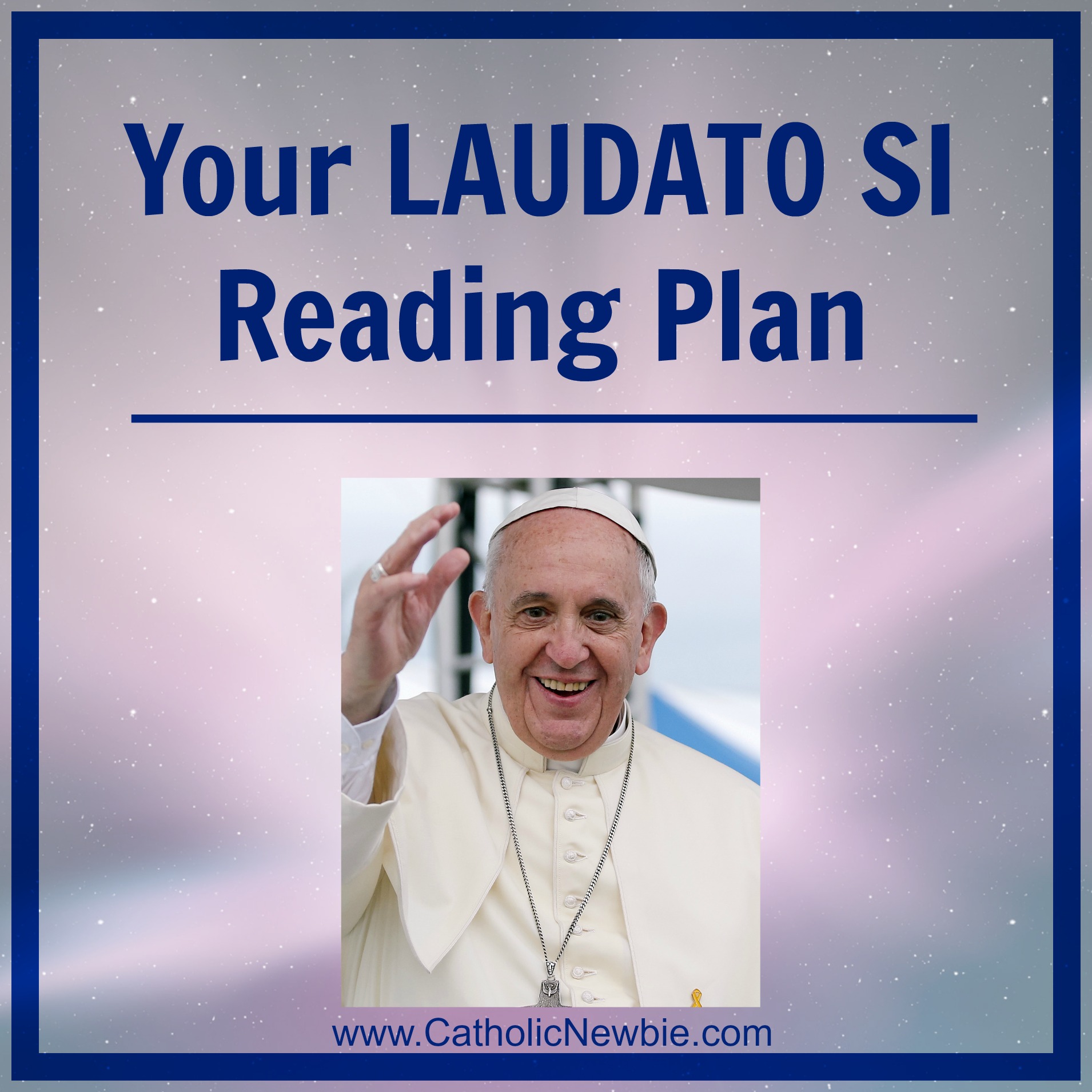
Laudato Si Reading Plan via @ACatholicNewbie

OK, Catholics (and ALL people for that matter), you already know this, but I’m here to remind you that you NEED to read Laudato Si, Pope Francis’ new encyclical letter On Care for Our Common Home. Why? Sure, you can read everyone else’s summaries, but you need to read Pope Francis’ words for yourself, rather than accept someone else’s interpretation.

You want to be especially careful you are not accepting the interpretations of secular media, who so frequently take Pope Francis’ comments out of context, turning them into something they are not. Teresa Tomeo posted a great list of reliable Catholic sources on her blog.

Format Options

How can you read Laudato Si? Here are some format choices:

1) Laudate App on your smartphone – Download the free app, then select Vatican Documents, scroll to Encyclical Letter and select the top one, Laudato si’. Easy as pie!

2) Vatican website – Read it directly online here.

3) Read as a book – You can buy Laudato Si in book format from Amazon.

4) Read it as an ebook – Download Laudato Si as an ebook to your Kindle or other e-reader.

Now you know HOW to read it, let’s put together a plan to actually read it. Because it’s divided into 246 parts and, as a book, is 176 pages, plus the fact that it’s written by a pope, can make it a bit intimidating to delve into. But I’m here to tell you, I’ve started reading it, and you don’t need a doctorate to get through it. Sure, you’ll need to concentrate, but you won’t need to whip out a dictionary to understand it.

My Reading Plan

My suggestion is to make it as easy as possible to read by having it on your phone, carrying your Kindle with you, packing the book in your bag, etc., so when you get a free moment, you can pop it out and read it. Having it in multiple formats can be helpful as well, so you can switch between ereading on your phone or Kindle to the physical book.

Tackle it in bits of 12-15 parts per day. At a rate of 15 parts, you’ll be done in 17 days, and at a rate of 12 parts, you’ll be done in 21 days — either way, you’ll have read it in less than a month in free bits of time here and there.

Great Quotes from Laudato Si Thus Far

I’m just at the beginning, but I’ve already found so many wonderful things in Laudto Si. Here are just a few samplings to inspire you to read (note: my favorite parts are in bold):

  • Pope Benedict asked us to recognize that the natural environment has been gravely damaged by our irresponsible behaviour. The social environment has also suffered damage. Both are ultimately due to the same evil: the notion that there are no indisputable truths to guide our lives, and hence human freedom is limitless. (Part 6)
  • [Patriarch Bartholomew] asks us to replace consumption with sacrifice, greed with generosity, wastefulness with a spirit of sharing, an asceticism which “entails learning to give, and not simply to give up. It is a way of loving, of moving gradually away from what I want to what God’s world needs. It is liberation from fear, greed and compulsion.” (Part 9)
  • “It is our humble conviction that the divine and the human meet in the slightest detail in the seamless garment of God’s creation, in the last speck of dust of our planet” (Part 9, quoting Patriarch Bartholomew, I believe) — How amazingly well written is that sentence?!
  • What is more, Saint Francis, faithful to Scripture, invites us to see nature as a magnificent book in which God speaks to us and grants us a glimpse of his infinite beauty and goodness. (Part 12)

Let us not waste the wise words of our wonderful Pope Francis by failing to read them! Now, let’s get started…
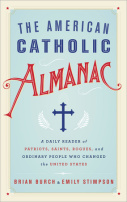
The Perfect Book for July 4th: The American Catholic Almanac

American Catholic AlmanacWhen learning about Church history and the saints, sometimes we forget that our own country has its own lofty Catholic history. While it may not date back hundreds or thousands of years, there are some amazing people and events that have taken place right here in the United States.

This July 4th is a great time to pick up the American Catholic Almanac from Image Catholic Books, which provides 365 days of inspirational stories of Catholics who have shaped America. Brian Burch and Emily Stimpson have put together an interesting Almanac to educate you about the church in your own country. Their goals were to tell the stories of the men and women who built the Catholic Church in America and show how much America has benefited from their efforts.

As you read these great stories of miracles and unwavering perseverance, the authors suggest you consider how their evangelization techniques might be used today. How can we model what these American saints accomplished and the virtues they displayed in modern times?

They note, “Perhaps, because so few of America’s first Catholics have the title ‘Saint’ before their name, we often forget that clouds of witnesses have lived on our shores.”

Did you know:

  • Jack Kerouac died wanting to be known as a Catholic and not only as a beat poet?
  • Andrew Jackson credited America’s victory in the Battle of New Orleans to the prayers of the Virgin Mary and the Ursuline Sisters?
  • Al Capone’s tombstone reads “My Jesus Mercy”

Fascinating stuff! Plus, it’s an easy read, as the book is laid out by date from January 1-December 31. Simply start on the day you pick up the book (why not July 4!), and read a story each day.

Celebrate the efforts of these Catholics and honor our own amazing country this July 4th by learning how our country was formed in the faith with The American Catholic Almanac.

I received a complimentary review copy of this book from Blogging for Books in exchange for an honest review.

Don’t Panic! Follow the Lead of Saints Athanasius, Augustine & Catherine

“God does not require that we be successful, only that we be faithful.” — Mother Teresa

St Augustine of Hippo

Augustine of Hippo (354–430 CE) as painted by Botticelli (c.1445–1510) Credit WikiImages

Many people are so very upset — and rightfully so — by the recent Supreme Court rulings upholding the Affordable Care Act and making it legal for individuals of the same sex to marry around the country. No doubt about it, this is a blow for Christians and Catholics in the United States. It’s disappointing to see the leaders of our country, which was founded on God, make laws against the fundamental truths of God, including the right to life for all and marriage as defined as between a man and a women.

After attending mass on Tuesday, the feast of the first martyrs of Rome, and reading the 2014 book called “Renewed: Ten Ways to Rediscover the Saints, Embrace Your Gifts, and Revive Your Catholic Faith” by Robert Reed (Ave Maria Press), I was reminded of how much the Church has been through since its founding. Certainly, the Catholic Church has been through WAY worse than this; in fact, this is barely a blip on the screen of persecution the Church has faced over time.

Can you imagine being one of the Roman martyrs, who lived in the time of the Emperor Nero when Christians were put to death in the most cruel manner possible for the entertainment of others? They lived in a society with a rule of law where Christians had NO rights and were killed for fun! But many persevered in their faith, going to their death as believers in Christ.

While I am not saying we shouldn’t be alarmed or stop encouragin our government to uphold the fundamental truths of God, I am saying we need not panic. We WILL get through this, even if it gets much worse — and it probably will. We need simply follow the model of many of our saints and martyrs who also lived through even worse persecution. As Blessed Mother Teresa’s quote so perfectly explains, sometimes God asks us to simply “work,” not be successful. It’s in the “doing” where we will find grace.

St. Athanasius

Take the example of St. Athanasius, featured in the book “Renewed,” as an example of remaining “steadfast in the truth.” Named the Bishop of Alexandria, he was exiled five times from his OWN diocese for defending the truth that Jesus Christ is of “one substance” with God the Father. No matter what happened to him — or in the society around him — he kept proclaiming the truth over and over and over again, just as we should do. Says Reed:

“Athanasius worked and taught in a time of tumult, radical change, and uncertainty about the future of both Church and society. In other words, his time has a lot in common with our own. And it is a wonderful thing that lives of courageous faith like that of Athanasius are still being lived today.” 

St. Augustine

Another example in Reed’s book, in which he pairs two saints together based on a virtue they displayed, usually one who lived long ago and another more modern saint, is St. Augustine. We all know the story of his dramatic conversion after his mother, St. Monica, prayed for so many years.

But did you know that as he lay dying, St. Augustine watched as the city from which he had preached the faith fell to vandals who had converted to Arianism (a heresy against Christ)? He had also earlier in his life witnessed the sacking of Rome. But did St. Augustine fall prey to despair and give up on the world or his country after all the work he had done? No, he fought the good fight, and in the words of St. Paul, “I have competed well; I have finished the race; I have kept the faith!”

St. Catherine of Siena

St. Catherine worked tirelessly until the age of 33 to advocate reform of the clergy, the return of the papacy from Avignon to Rome, to heal the great Western schism and persuade others of the legitimacy of a new pope, Urban VI. This young woman, the daughter of a cloth dyer, dared to write letters to and visit popes to follow the path she was being led by Christ. Despite the constant conflict around her, she pressed on boldly.

These are just a tiny portion of the multitude of saints who have set such an example for us. The world might be falling apart around us, but remember all the persecution and trials that have passed before us. We need to keep the faith and keep on keeping on with the truth as we know it, and give the rest to God, knowing that His will be done.

Just as so many Christians before us have endured great torment, mockery and attempted destruction of their faith, so we may, too. But Christ promised that the gates of hell would not prevail against the Church. So let’s show the world what it means to be a Christian and put on the full armor of God, living our faith to its fullest completion, knowing that Christ wins in the end. Let us be faithful, even if we are not successful.

Note: Renewed was provided to me at no cost in exchange for a complete and honest review.

Two Amazing Insights on the Visitation

Virgin Mary - The Visitation

I’ve been blown away recently by two key items I’d overlooked with reading or meditating on the Visitation, the moment when Mary and Elizabeth meet and John the Baptist jumps in his mother’s womb.

1) Mary, as the Mother of God — Catholics are often criticized for giving Mary the title Mother of God. It seems other Christians want to see her as only the mother of Jesus. Of course, logically, this is incorrect. Jesus is BOTH fully human and fully God. You can’t separate the two, so if Jesus is God and Mary is the Mother of Jesus, then Mary is the Mother of God.

But, here’s more proof… Did you ever notice that Elizabeth, whom the Bible says is filled with the Holy Spirit, calls Mary the “mother of our Lord” (Luke 1:41-43)? Sure, you could say that she really is referring to Jesus, who is also called Lord (but let us remember that we cannot separate the Holy Trinity, so that is referring to God, as well). But in the entire passage of Elizabeth’s statements to Mary, she is referring to God the Father. Right there, the Holy Spirit declares Mary the “Mother of God.”

2) Mary as the NEW Ark of the Covenant — Here’s another doozy that really blew my mind when I read it in Denise Bossert’s “Gifts of the Visitation” (Ave Maria Press, 2015). Catholics also call Mary the new Ark of the Covenant, because just as the old Ark of the Covenant carries God, so does Mary with Jesus in her womb. BUT, Bossert points out that there is an Old Testament verse that prefigures the Visitation, which speaks to this even further.

In 2 Samuel 6 (you MUST go read this!), David asks “How can the ark of the Lord come to me?” and then is described as dancing and jumping before the Ark. In the Visitation verses in Luke, Elizabeth says, “And how does this happen to me, that the Mother of my Lord should come to me?” (Luke 1:43) and John the Baptist “leaps” in his mother’s womb. Does that not show Mary as the new Ark of the Covenant? Amazing stuff!

Had you ever thought about these things? Please share your thoughts!